
Plant and animal cells behave differently when exosmosis or endosmosis occurs, due to their structural differences:
1. Plant cells have a cell wall, which allows for only slight changes in size, and also prevents lysis of the cells.
2. Plant cells have large central vacuoles, which are not present in animal cells. Hence during osmosis, water moves between cell sap in central vacuole and the solution surrounding the cells. For animal cells, water moves between cytoplasm and the solution surrounding the cells.
Cell surface membranes affect the entry and exit of water and substances.
Factors that affect diffusion and osmosis are:
1. Surface area available: An increase in surface area leads to an increase in rate of diffusion and osmosis.
2. Permeability of membranes: Usually cell membranes are partially permeable. However, when membranes are exposed to organic solvents which dissolve the lipid bilayer (eg. ethanol or ether), or when cells are heated, the structure of the lipid bilayer is disrupted. This means that the membrane becomes fully permeable, which allows larger molecules inside the cell (eg. proteins) to diffuse out of the cell.
Points to Note for Structured Qn on Osmosis:
Turgid, Flaccid and Plasmolysis are terms used only for PLANT cells.
Instead, for a RBC, terms like haemolysis (bursting or lysis) and crenation (shrinkage) should be used.
Terms such as Exosmosis and Endosmosis should be used when referring to living cells only. The term Osmosis should be used when referring to experiments with non-living membranes such as visking tubings/dialysis tubings.
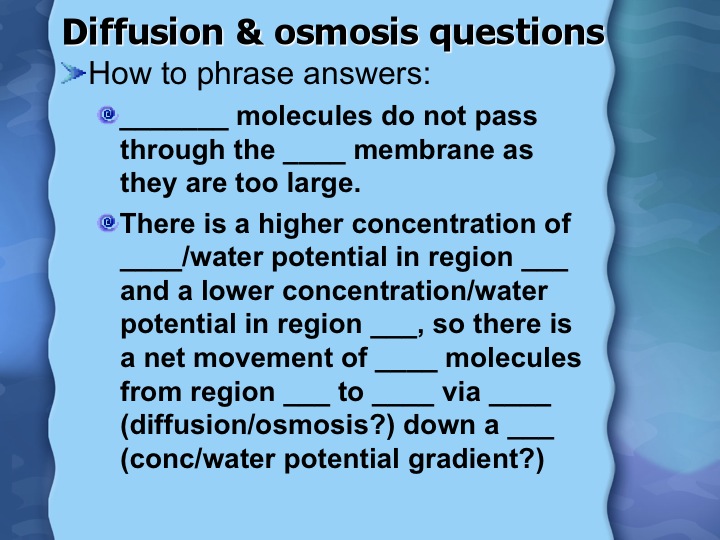
When referring to osmosis, use the term water potential, not water concentration as well as water potential gradient, not concentration gradient.
State specifically the shape of the RBC as being flattened and bi-concave.
If there is equal water potential in both cell and solution, state that the water potential gradient is zero resulting in no net movement of water molecules, thus no osmosis.
Use the template that is on the blog to help you phrase your answers!

Question on Enzymes
Describe how you would investigate the effect of temperature changes on the activity of the enzyme amylase. [10m]
1. Use a dropper to place drops of iodine solution on a white tile.
2. Label five test tubes 10, 30, 50, 70, 90 to indicate the temperatures at which they would be incubated at and add 10 cm3 of starch suspension into each of these tubes.
3. Use the five beakers provided to set up water baths maintained at temperatures of 100C, 300C, 500C, , 700C and 900C respectively.
4. Place each of these tubes in their corresponding water baths and leave them for 10 minutes.
5. After 10 minutes, add 1 cm3 of amylase solution into each test tube and shake the test tube gently. Immediately after adding the amylase solution, start the stopwatch and return the tube to the water bath.
6. Use clean plastic droppers to remove one drop from each of the starch-amylase mixtures and add them to the iodine droplets on the white tile to test for the presence of starch.
7. Repeat step 6 at regular intervals of 2 minutes for the next 15 minutes, and ensure that the temperature of the water baths does not fluctuate too much.
8. For each of the test tubes, record the time taken for starch to be digested completely (when iodine solution remains yellow).
9. Plot a graph of the time taken for the complete digestion of starch against temperature.
10.The shorter the time taken to digest the starch, the faster the rate of reaction indicating faster enzyme activity.
1. Use a dropper to place drops of iodine solution on a white tile.
2. Label five test tubes 10, 30, 50, 70, 90 to indicate the temperatures at which they would be incubated at and add 10 cm3 of starch suspension into each of these tubes.
3. Use the five beakers provided to set up water baths maintained at temperatures of 100C, 300C, 500C, , 700C and 900C respectively.
4. Place each of these tubes in their corresponding water baths and leave them for 10 minutes.
5. After 10 minutes, add 1 cm3 of amylase solution into each test tube and shake the test tube gently. Immediately after adding the amylase solution, start the stopwatch and return the tube to the water bath.
6. Use clean plastic droppers to remove one drop from each of the starch-amylase mixtures and add them to the iodine droplets on the white tile to test for the presence of starch.
7. Repeat step 6 at regular intervals of 2 minutes for the next 15 minutes, and ensure that the temperature of the water baths does not fluctuate too much.
8. For each of the test tubes, record the time taken for starch to be digested completely (when iodine solution remains yellow).
9. Plot a graph of the time taken for the complete digestion of starch against temperature.
10.The shorter the time taken to digest the starch, the faster the rate of reaction indicating faster enzyme activity.
March Holiday Assignment!
Dear Marists,
Here is the March Holiday assignment for Biology.
1. WS 4.1-4.3
2. TYS Unit 1.2 (All Questions)
3. Ecology Topic 9, Self Study
4. Research Project (Pair work)
RESEARCH PROJECT DETAILS
For the research project, you will need to work with a partner. You can choose anyone that you would like to work with. You may choose 1 topic from the following 2 topics.
A. Stem Cells
B. Trans-Fat
You will need to come up with 5 powerpoint slides.
Prepare the 5 powerpoint slides, for use in a presentation to a non-scientific audience on the topic area.
That means that the slides must be comprehensive enough to include the science behind the topic but must be presented in a simple way so that all can understand.
These assignments are due on the first lesson for Biology when school reopens in Term 2.
Please upload the ppt slide in your e-portfolio. The both of you must upload it into your own e-portfolio. Please name your slide 'Biology Research (Stem cell/Trans fat) Class 3_, No _ and _'
Here is the March Holiday assignment for Biology.
1. WS 4.1-4.3
2. TYS Unit 1.2 (All Questions)
3. Ecology Topic 9, Self Study
4. Research Project (Pair work)
RESEARCH PROJECT DETAILS
For the research project, you will need to work with a partner. You can choose anyone that you would like to work with. You may choose 1 topic from the following 2 topics.
A. Stem Cells
B. Trans-Fat
You will need to come up with 5 powerpoint slides.
Prepare the 5 powerpoint slides, for use in a presentation to a non-scientific audience on the topic area.
That means that the slides must be comprehensive enough to include the science behind the topic but must be presented in a simple way so that all can understand.
These assignments are due on the first lesson for Biology when school reopens in Term 2.
Please upload the ppt slide in your e-portfolio. The both of you must upload it into your own e-portfolio. Please name your slide 'Biology Research (Stem cell/Trans fat) Class 3_, No _ and _'
Diffusion, Osmosis and Active Transport: Summary
Molecules in a liquid, aqueous solution or a gas would have kinetic energy and would be moving in random directions.
If there are more of a specific type of molecule in one region and less in another region, you will find that the distribution of these molecules will even out after some time.
This NET (overall) movement of molecules from the more concentrated region to the less concentrated region is known as DIFFUSION.
The stage where the molecules are evenly distributed is known as DYNAMIC EQUILIBRIUM. (DYNAMIC: Molecules are still moving in random directions, EQUILIBRIUM: Molecules are evenly distributed)
This movement occurs spontaneously and does not require energy: PASSIVE TRANSPORT.
A similar kind of movement occurs when water molecules are involved. When this occurs across a partially permeable membrane, we call this process OSMOSIS.
Both osmosis and diffusion occur DOWN a water potential/concentration GRADIENT.
Water always enters and leaves the cells and bloodstream through osmosis.
For other solutes, eg. glucose, cells usually cannot just rely on diffusion to take in glucose (as it only enables cells to take up glucose until equilibrium is reached). Hence usually cells will sometimes pump in solutes using energy: ACTIVE TRANSPORT.
Main factors affecting diffusion/osmosis:
Temperature: Increasing temp makes the molecules gain KE. More KE, faster movement, faster rate of diffusion.
Surface area of membrane across which transport of molecules occurs: Increasing surface area means more molecules can cross the membrane at any one time, this increases rate of diffusion.
Gradient: The steeper the gradient (ie, the greater the difference in conc between the 2 regions), the faster the rate of diffusion.


If there are more of a specific type of molecule in one region and less in another region, you will find that the distribution of these molecules will even out after some time.
This NET (overall) movement of molecules from the more concentrated region to the less concentrated region is known as DIFFUSION.
The stage where the molecules are evenly distributed is known as DYNAMIC EQUILIBRIUM. (DYNAMIC: Molecules are still moving in random directions, EQUILIBRIUM: Molecules are evenly distributed)
This movement occurs spontaneously and does not require energy: PASSIVE TRANSPORT.
A similar kind of movement occurs when water molecules are involved. When this occurs across a partially permeable membrane, we call this process OSMOSIS.
Both osmosis and diffusion occur DOWN a water potential/concentration GRADIENT.
Water always enters and leaves the cells and bloodstream through osmosis.
For other solutes, eg. glucose, cells usually cannot just rely on diffusion to take in glucose (as it only enables cells to take up glucose until equilibrium is reached). Hence usually cells will sometimes pump in solutes using energy: ACTIVE TRANSPORT.
Main factors affecting diffusion/osmosis:
Temperature: Increasing temp makes the molecules gain KE. More KE, faster movement, faster rate of diffusion.
Surface area of membrane across which transport of molecules occurs: Increasing surface area means more molecules can cross the membrane at any one time, this increases rate of diffusion.
Gradient: The steeper the gradient (ie, the greater the difference in conc between the 2 regions), the faster the rate of diffusion.

Common Test 1 23/2
Section A: 10 MCQs (10 marks)
Section B: Structured Questions (30 marks)
Section C: Essay Question (10 marks)
Answer all questions.
Time: 1 Hr
Topic 1: Cells
T2: Biomolecules + Food Tests
T3: Enzymes
Please make sure you have a sharp pencil and an eraser and your other necessary stationary with you. You will also need your calculator.
Manage your time well.
You are advised to spend a max of 20 mins on Section A: MCQ.
Section B: Structured Questions (30 marks)
Section C: Essay Question (10 marks)
Answer all questions.
Time: 1 Hr
Topic 1: Cells
T2: Biomolecules + Food Tests
T3: Enzymes
Please make sure you have a sharp pencil and an eraser and your other necessary stationary with you. You will also need your calculator.
Manage your time well.
You are advised to spend a max of 20 mins on Section A: MCQ.
Enzymes
ENZYME: biological catalyst made of protein which alter the rate of chemical reactions, remaining unchanged at the end of reaction.
SUBSTRATE: substances upon which enzymes act.
WHY BIOLOGICAL?
Produced by living cells
Protein in nature (and hence can be denatured by extreme pH and heat)
WHY CATALYSTS?
Alter rate of chemical reactions
But are not changed at the end of the reaction
Hence required in minute (ie small) amounts as they can be REUSED
Lock & Key Hypothesis
To explain why enzymes are SPECIFIC in action
Enzyme = Lock
Substrate = Key
For key to fit into lock, it has to have a shape that is COMPLEMENTARY to the shape of the lock. Similarly, for the enzyme to act on the substrate, the substrate must have a shape that is COMPLEMENTARY to the ACTIVE SITE of the enzyme.
Why are enzymes important?
Enable all the chemical reactions in the body to run, without requiring extreme conditions like high heat.
Hence body must maintain a suitable environment for enzymes to function as near optimum as possible.
Commonly used terms:
1. Control: Set-up used to provide standard conditions to be compared with experimental conditions, to study the effect of a factor on a process by removing or varying the factor. In enzyme experiments, the control set-up usually shows that the changes observed are due to the action of the enzyme (eg. oxygen gas produced is due to action of catalase). The control usually involves a similar set-up, but uses boiled enzyme that would be denatured, and hence will not be able to produce a reaction.
2. Action of enzyme: Basically used to refer to the effect of the enzyme (eg. Action of catalase- Breaks down hydrogen peroxide into oxygen which appears as froth.)
3. Chemical nature: Refers to what kind of chemical makes up the molecule, and the characteristics of the chemical (eg. protein in nature means the molecules can be denatured by high heat/extreme pH). Read up important concepts for temp and pH effects on enzymes in notes.

4. Rate of reaction: Measure of how fast a reaction is running, based on
a. Amount of substrate used up/Time taken
b. Amount of product formed/Time taken
5. Effects of Substrate and Enzyme Concentration
Terms to take note of:
• Limiting factor: A factor that directly affects the rate at which chemical reaction progresses. Increasing quantity of this factor will increase the rate of reaction.
• End Point: Reaction has been completed. All substrates have been used up.
• Saturation Point: All the enzymes have been made use of. Enzyme concentration is the limiting factor.
*For enzyme graphs;
take note of the axes, gradient of the curves and where the curve plateaus.
SUBSTRATE: substances upon which enzymes act.
WHY BIOLOGICAL?
Produced by living cells
Protein in nature (and hence can be denatured by extreme pH and heat)
WHY CATALYSTS?
Alter rate of chemical reactions
But are not changed at the end of the reaction
Hence required in minute (ie small) amounts as they can be REUSED
Lock & Key Hypothesis
To explain why enzymes are SPECIFIC in action
Enzyme = Lock
Substrate = Key
For key to fit into lock, it has to have a shape that is COMPLEMENTARY to the shape of the lock. Similarly, for the enzyme to act on the substrate, the substrate must have a shape that is COMPLEMENTARY to the ACTIVE SITE of the enzyme.
Why are enzymes important?
Enable all the chemical reactions in the body to run, without requiring extreme conditions like high heat.
Hence body must maintain a suitable environment for enzymes to function as near optimum as possible.
Commonly used terms:
1. Control: Set-up used to provide standard conditions to be compared with experimental conditions, to study the effect of a factor on a process by removing or varying the factor. In enzyme experiments, the control set-up usually shows that the changes observed are due to the action of the enzyme (eg. oxygen gas produced is due to action of catalase). The control usually involves a similar set-up, but uses boiled enzyme that would be denatured, and hence will not be able to produce a reaction.
2. Action of enzyme: Basically used to refer to the effect of the enzyme (eg. Action of catalase- Breaks down hydrogen peroxide into oxygen which appears as froth.)
3. Chemical nature: Refers to what kind of chemical makes up the molecule, and the characteristics of the chemical (eg. protein in nature means the molecules can be denatured by high heat/extreme pH). Read up important concepts for temp and pH effects on enzymes in notes.

4. Rate of reaction: Measure of how fast a reaction is running, based on
a. Amount of substrate used up/Time taken
b. Amount of product formed/Time taken
5. Effects of Substrate and Enzyme Concentration
Terms to take note of:
• Limiting factor: A factor that directly affects the rate at which chemical reaction progresses. Increasing quantity of this factor will increase the rate of reaction.
• End Point: Reaction has been completed. All substrates have been used up.
• Saturation Point: All the enzymes have been made use of. Enzyme concentration is the limiting factor.
*For enzyme graphs;
take note of the axes, gradient of the curves and where the curve plateaus.
To all Sec 3 Pure Biology Students..
Please note that this blog will be used for uploading summaries, things to note, reminders, as well as practice questions especially when the exams draw nearer. Should you have questions that are not addressed during lessons, you can also ask your questions in the comments section (Do remember to leave your name and class when you post questions).
Subscribe to:
Posts (Atom)