
Dear Marists,
Here is the revision schedule in order of priority for Prelim 1.
1. SPA Revision
2. Topical TYS
Units 3.1 A and 3.1 B Reproduction in Plants and Man
Units 3.2 and 3.4 Cell Division & Inheritance
2. Extra TYS Practice
Reproduction in Plants
Reproduction in Man
Genetics & Inheritance
Excretion
3. MSHS Prelim 1 Papers 2010-2012

2013 T1 SOW
Dear Marists,
The SOW for 2013 can be found under the link Revision on the right.
Heres the SOW for Term 1.

The SOW for 2013 can be found under the link Revision on the right.
Heres the SOW for Term 1.


Main Points- Nutrition and Transport in Man
TRANSPORT IN MAN (T6.1, 6.2 ONLY)
-Structure of arteries: thick muscular and elastic walls / no valves
-Structure of veins: thin muscular walls / valves present / movement of blood aided by contraction of skeletal muscles on the veins (blood is pushed along the vein)
-Structure of capillaries: one cell thick endothelium / thin walled (increase rate of exchange) of materials by diffusion
-Cardiac cycle: atrial systole / diastole / ventricular systole / diastole / contraction / relaxation / cardiac muscle / bicuspid valve / tricuspid valve / blood flows / pulmonary artery / aorta / semi lunar valves (aortic and pulmonary valve)
NUTRITION IN MAN
main parts of the digestive system (name and know the functions)
-Digestion take place in 3 places:
a)Mouth: Starch / salivary amylase
b)Stomach: pepsin / protein to polypeptides / HCl / functions of HCl
c)Small intestine: alkaline / villus / pancreas / pancreatic juice(TAL) / intestinal juice(EELMLS) / No digestion in the large intestine
-2 types of amylase: salivary, pancreatic (be specific)
-know products of all the enzyme reactions in the digestive system
eg: starch => maltose
fats => fatty acids + glycerol
proteins => peptones/polypeptides => amino acids
-assimilation IS NOT digestion or absorption!!!
Function of hepatic portal vein (from small intestine to liver for assimilation)
-Absorption: small intestine / villus / adaptations of villus/ lacteals / fatty acids / glycerol
-Assimilation: liver / bile / glycogen / excess glucose / deamination of excess amino acids / urea / urea excreted in urine
-Other functions of liver NOT related to digestive system: breakdown red blood cells / breakdown alcohol
-Structure of arteries: thick muscular and elastic walls / no valves
-Structure of veins: thin muscular walls / valves present / movement of blood aided by contraction of skeletal muscles on the veins (blood is pushed along the vein)
-Structure of capillaries: one cell thick endothelium / thin walled (increase rate of exchange) of materials by diffusion
-Cardiac cycle: atrial systole / diastole / ventricular systole / diastole / contraction / relaxation / cardiac muscle / bicuspid valve / tricuspid valve / blood flows / pulmonary artery / aorta / semi lunar valves (aortic and pulmonary valve)
NUTRITION IN MAN
main parts of the digestive system (name and know the functions)
-Digestion take place in 3 places:
a)Mouth: Starch / salivary amylase
b)Stomach: pepsin / protein to polypeptides / HCl / functions of HCl
c)Small intestine: alkaline / villus / pancreas / pancreatic juice(TAL) / intestinal juice(EELMLS) / No digestion in the large intestine
-2 types of amylase: salivary, pancreatic (be specific)
-know products of all the enzyme reactions in the digestive system
eg: starch => maltose
fats => fatty acids + glycerol
proteins => peptones/polypeptides => amino acids
-assimilation IS NOT digestion or absorption!!!
Function of hepatic portal vein (from small intestine to liver for assimilation)
-Absorption: small intestine / villus / adaptations of villus/ lacteals / fatty acids / glycerol
-Assimilation: liver / bile / glycogen / excess glucose / deamination of excess amino acids / urea / urea excreted in urine
-Other functions of liver NOT related to digestive system: breakdown red blood cells / breakdown alcohol
Nutrition in Man- A Summary
Nutrition in mammals involves:
1. Ingestion of food into body
2. Digestion of food into smaller molecules that can be absorbed into cells
3. Absorption and uptake of nutrients into cells
4. Assimilation: Use of nutrients for energy or making protoplasm
5. Egestion: Removal of undigested and unabsorbed material from the body
This involves the action of the digestive system, which consists of the gut (tube stretching from mouth to anus) and the other glands such as the liver and pancreas.
Gut structure:
1. Outer layer: Serosa (serous coat), secretes oily fluid to reduce friction due to rubbing of the exterior of the organs against each other.
2. Muscle layer: 2 layers of muscle (stomach has 3 layers) arranged in rings (circular muscle), and lengthwise (longitudinal muscle). These contract and relax to bring about peristalsis to push food along the gut.
3. Submucosa (submucous coat): Layer with blood vessels. Blood vessels are required to bring oxygen to gut cells, and to bring digested food to other parts of body. [Sub just means "under", hence the submucosa is just the layer below the mucosa.]
4. Mucosa (Mucous coat): As the name suggests, the layer contains the glands, which produce mucus (for lubrication of food), as well as digestive enzymes and other substances like acid. This is the layer nearest to the lumen of the gut.
Digestion
Can be classified as:
1. Physical: Mechanical breakdown of food into smaller particles, without the use of enzymes. Eg. Mastication in buccal cavity, churning in stomach, emulsification of fats in small intestine.
2. Chemical: Breakdown of food, involving the breaking of chemical bonds, which hence requires the action of enzymes. Eg. Digestion of amylase into maltose by amylase.
Important note: When describing chemical digestion processes, you must include in your answer:
1. Name of enzyme
2. Source of enzyme (where is enzyme made?)
3. Substrate that enzyme acts on
4. Product formed from reaction
Additional Notes
1. All proteases (enzymes that act on proteins/peptones) usually end with "-in" (pepsin, rennin, trypsin, erepsin).
2. Proteases that act on proteins must be produced in the inactive form inside cells, or the protease will cause the destruction of the cell as it will digest the proteins in the cell. Activation of the proteases depends on the type of protease: Those in the stomach are activated by acid, those in the small intestine (trypsin) is activated by another enzyme, enterokinase (from intestinal glands). This ensures protease is only activated in the lumen of the gut.
3. Bile salts allow for PHYSICAL digestion (emulsification) of fats into smaller fat globules, which increases the surface area available for lipase to act on, hence increasing rate of lipase action. Bile salts also allow for the absorption of fatty acids into epithelial cells of villus. They allow the entry of fatty acids and glycerol, after which they then return to the lumen of the small intestine, where the process is repeated again.
4. Bile pigments DO NOT play a digestive function. They are just excretory products, formed from the breakdown of haemoglobin during the destruction of old red blood cells. Of course, since they are pigments, they give faeces their brown colour (but that's not a function!), and are removed out along with the faeces.
5. Digestion of fats: Fats are physically broken into fat globules (emulsification) by action of bile (produced by liver, stored in gall bladder). This increases surface area for lipase (from pancreas and intestinal glands) to digest the lipids into fatty acids and glycerol (chemical digestion).
1. Ingestion of food into body
2. Digestion of food into smaller molecules that can be absorbed into cells
3. Absorption and uptake of nutrients into cells
4. Assimilation: Use of nutrients for energy or making protoplasm
5. Egestion: Removal of undigested and unabsorbed material from the body
This involves the action of the digestive system, which consists of the gut (tube stretching from mouth to anus) and the other glands such as the liver and pancreas.
Gut structure:
1. Outer layer: Serosa (serous coat), secretes oily fluid to reduce friction due to rubbing of the exterior of the organs against each other.
2. Muscle layer: 2 layers of muscle (stomach has 3 layers) arranged in rings (circular muscle), and lengthwise (longitudinal muscle). These contract and relax to bring about peristalsis to push food along the gut.
3. Submucosa (submucous coat): Layer with blood vessels. Blood vessels are required to bring oxygen to gut cells, and to bring digested food to other parts of body. [Sub just means "under", hence the submucosa is just the layer below the mucosa.]
4. Mucosa (Mucous coat): As the name suggests, the layer contains the glands, which produce mucus (for lubrication of food), as well as digestive enzymes and other substances like acid. This is the layer nearest to the lumen of the gut.
Digestion
Can be classified as:
1. Physical: Mechanical breakdown of food into smaller particles, without the use of enzymes. Eg. Mastication in buccal cavity, churning in stomach, emulsification of fats in small intestine.
2. Chemical: Breakdown of food, involving the breaking of chemical bonds, which hence requires the action of enzymes. Eg. Digestion of amylase into maltose by amylase.
Important note: When describing chemical digestion processes, you must include in your answer:
1. Name of enzyme
2. Source of enzyme (where is enzyme made?)
3. Substrate that enzyme acts on
4. Product formed from reaction
Additional Notes
1. All proteases (enzymes that act on proteins/peptones) usually end with "-in" (pepsin, rennin, trypsin, erepsin).
2. Proteases that act on proteins must be produced in the inactive form inside cells, or the protease will cause the destruction of the cell as it will digest the proteins in the cell. Activation of the proteases depends on the type of protease: Those in the stomach are activated by acid, those in the small intestine (trypsin) is activated by another enzyme, enterokinase (from intestinal glands). This ensures protease is only activated in the lumen of the gut.
3. Bile salts allow for PHYSICAL digestion (emulsification) of fats into smaller fat globules, which increases the surface area available for lipase to act on, hence increasing rate of lipase action. Bile salts also allow for the absorption of fatty acids into epithelial cells of villus. They allow the entry of fatty acids and glycerol, after which they then return to the lumen of the small intestine, where the process is repeated again.
4. Bile pigments DO NOT play a digestive function. They are just excretory products, formed from the breakdown of haemoglobin during the destruction of old red blood cells. Of course, since they are pigments, they give faeces their brown colour (but that's not a function!), and are removed out along with the faeces.
5. Digestion of fats: Fats are physically broken into fat globules (emulsification) by action of bile (produced by liver, stored in gall bladder). This increases surface area for lipase (from pancreas and intestinal glands) to digest the lipids into fatty acids and glycerol (chemical digestion).
E-Learning Day 2012
Dear Biology Students,
Please take note the assignments that require completion on ELD.
Please go to the lesson titled '12 ELD Sec 3 Pure Biology' on Ask n Learn and download the 3 files attached.
They are
1: CHD_Lesson
2. CHD_Handout
3. ABO_Blood_Grps_lesson
Spend some time reading and understanding these 2 sub topics.
You may refer to your notes as well as textbook under Topic 5, Transport in Man to further substantiate your learning.
After which, go to 12 ELD Sec3 Pure Biology Quiz and take the Quiz.
You have 30 mins to complete the 12 MCQ Questions.
You may only attempt the Quiz once so please ensure that you have understood the topic before doing the quiz.
Enjoy E learning!
Please take note the assignments that require completion on ELD.
Please go to the lesson titled '12 ELD Sec 3 Pure Biology' on Ask n Learn and download the 3 files attached.
They are
1: CHD_Lesson
2. CHD_Handout
3. ABO_Blood_Grps_lesson
Spend some time reading and understanding these 2 sub topics.
You may refer to your notes as well as textbook under Topic 5, Transport in Man to further substantiate your learning.
After which, go to 12 ELD Sec3 Pure Biology Quiz and take the Quiz.
You have 30 mins to complete the 12 MCQ Questions.
You may only attempt the Quiz once so please ensure that you have understood the topic before doing the quiz.
Enjoy E learning!
Nutrition in Plants- A Summary
What is photosynthesis?
It is the process by which green plants trap light energy using chlorophyll and convert it to chemical energy for the production of glucose from water and carbon dioxide.
Oxygen is released as a by-product.
Adaptations of the leaf
Leaf is an organ specialized for photosynthesis.
Its broad and thin lamina provides and large surface area for maximum absorption of light.
The thin lamina allows carbon dioxide to enter/diffuse into the cells quickly.
The palisade cells contains numerous chloroplast and are packed closely together at the upper surface of the leaf.
This enables them to absorb light energy efficiently.
The spongy mesophyll cells are loosely packed so that large intercellular spaces are present for rapid diffusion of gaseous exchange.
The numerous stomata at the lower epidermis allows rapid gaseous exchange between the leaf and the air.
The extensive vain system of xylem and phloem help to provide rapid transport of water to, and manufactured food from the leaf.
Effects of varying light intensity on photosynthesis.
Light energy is trapped by chlorophyll to split water molecules during photosynthesis.
Increasing light energy will speed up photolysis, hence increasing photosythesis.
Effects of varying wavelights on photosynthesis.
Red and blue wavelights highly absorbed.
Green and yellow reflected.
More light absorbed will increase rate of photosynthesis.
Effects of varying carbon dioxide on photosynthesis
Increased CO2, increases rate of glucose produced, resulting in increase in rate of photosynthesis.
Effects of varying temperature on photosynthesis
Temperature affects rate of enzyme-catalysed reaction in photosynthesis.
Low temperature: enzymes inactive
High temperature: enzymes denature and no photosynthesis takes place.
MCQ Questions
1. The word equation which best describes photosynthesis is .
a. carbon dioxide + energy → glucose + oxygen + water
b. glucose + oxygen → water + carbon dioxide + energy
c. glucose + oxygen → water + carbon dioxide + energy
d. water + carbon dioxide + energy → glucose + oxygen
2. Which of the following cells of a leaf do not have chloroplasts?
a. Guard cells
b. Palisade mesophyll
c. Spongy mesophyll
d. Upper epidermis
3. How does most of the carbon dioxide enter the photosynthesising cells of a leaf?
a. Diffusion through the epidermis of the leaf
b. Diffusion through the stomata of the leaf
c. Diffusion through the xylem in the leaf
d. Diffusion through the phloem in the leaf
4. Which of the following statements is the most accurate?
a. Food can travel up the stem in the phloem.
b. Food can travel up or down the stem in the xylem.
c. Food can travel up or down the stem in the phloem.
d. Food can travel down the stem in the phloem.
5. Which of the following conditions is least likely to increase the rate of transpiration in a plant?
a. a rise in temperature.
b. an increase in humidity.
c. increased air movement.
d. increased sunlight
MCQ Answers
1. d
2. d
3. b
4. b
5. b
Structured Question Worked Solutions
1. The equation for photosynthesis is usually given as:
a. Which cell organelle does photosynthesis occur in?
b. Comment on the accuracy of the given equation in describing the process of
photosynthesis.
Solution
a. Chloroplast
b. The equation is not very accurate because it does not show that photosynthesis is a two-step process
only one step is light-dependent and the other is light-independent water is formed during the light-independent stage.
2. Discuss the major adaptations of the leaf to photosynthesis.
Solution
The petiole holds the leaf lamina away from the stem so that the lamina can absorb suffi cient sunlight and air.
The leaf lamina has a large fl at surface compared to its volume.
This enables the leaf to absorb the maximum amount of sunlight for photosynthesis.
A thin expanded lamina ensures that carbon dioxide, the raw material for photosynthesis, can rapidly reach the inner cells of the leaf.
A network of veins extends throughout the leaf. Veins are made of the vascular tissues, xylem and phloem. Xylem transports water and mineral salts to the leaf cells. Phloem transports sugars away from the leaf cells to other parts of the plant. This maintains a concentration gradient so that the photosynthetic reactions proceed in the forward direction.
A waxy cuticle on the leaf epidermis protects the leaf by reducing evaporation of water. Water is an essential raw material for photosynthesis. Lack of water would also make the leaf wilt, reducing surface area for light absorption.
Stomata on the lower epidermis open in sunlight, allowing carbon dioxide to diffuse in and oxygen to diffuse out.
Mesophyll cells of the leaf contain numerous chloroplasts. Chloroplasts contain chlorophyll, which absorbs light energy for photosynthesis.
Mesophyll cells in the upper regions of the leaf (palisade mesophyll) contain more chloroplasts since more light energy can be absorbed near the leaf surface.
An interconnecting system of air spaces in the lower regions of the leaf (spongy mesophyll) allow rapid diffusion of carbon dioxide into mesophyll cells.
3. Discuss why the following statement is true: “Temperature will only increase the rate of photosynthesis to a certain extent. At very high temperatures, the rate of photosynthesis will decrease.”
Solution
Photosynthesis is an enzyme-catalysed reaction.
There will be increased collision of enzyme and substrate as temperature increases.
This results in more enzyme-substrate complex being formed and thus a greater rate of reaction. However, at very high temperatures, enzymes being protein in nature, will be denatured.
The substrate no longer fits into the active site and an enzyme-substrate complex cannot be formed.
Thus the rate of photosynthesis will decrease.
It is the process by which green plants trap light energy using chlorophyll and convert it to chemical energy for the production of glucose from water and carbon dioxide.
Oxygen is released as a by-product.
Adaptations of the leaf
Leaf is an organ specialized for photosynthesis.
Its broad and thin lamina provides and large surface area for maximum absorption of light.
The thin lamina allows carbon dioxide to enter/diffuse into the cells quickly.
The palisade cells contains numerous chloroplast and are packed closely together at the upper surface of the leaf.
This enables them to absorb light energy efficiently.
The spongy mesophyll cells are loosely packed so that large intercellular spaces are present for rapid diffusion of gaseous exchange.
The numerous stomata at the lower epidermis allows rapid gaseous exchange between the leaf and the air.
The extensive vain system of xylem and phloem help to provide rapid transport of water to, and manufactured food from the leaf.
Effects of varying light intensity on photosynthesis.
Light energy is trapped by chlorophyll to split water molecules during photosynthesis.
Increasing light energy will speed up photolysis, hence increasing photosythesis.
Effects of varying wavelights on photosynthesis.
Red and blue wavelights highly absorbed.
Green and yellow reflected.
More light absorbed will increase rate of photosynthesis.
Effects of varying carbon dioxide on photosynthesis
Increased CO2, increases rate of glucose produced, resulting in increase in rate of photosynthesis.
Effects of varying temperature on photosynthesis
Temperature affects rate of enzyme-catalysed reaction in photosynthesis.
Low temperature: enzymes inactive
High temperature: enzymes denature and no photosynthesis takes place.
MCQ Questions
1. The word equation which best describes photosynthesis is .
a. carbon dioxide + energy → glucose + oxygen + water
b. glucose + oxygen → water + carbon dioxide + energy
c. glucose + oxygen → water + carbon dioxide + energy
d. water + carbon dioxide + energy → glucose + oxygen
2. Which of the following cells of a leaf do not have chloroplasts?
a. Guard cells
b. Palisade mesophyll
c. Spongy mesophyll
d. Upper epidermis
3. How does most of the carbon dioxide enter the photosynthesising cells of a leaf?
a. Diffusion through the epidermis of the leaf
b. Diffusion through the stomata of the leaf
c. Diffusion through the xylem in the leaf
d. Diffusion through the phloem in the leaf
4. Which of the following statements is the most accurate?
a. Food can travel up the stem in the phloem.
b. Food can travel up or down the stem in the xylem.
c. Food can travel up or down the stem in the phloem.
d. Food can travel down the stem in the phloem.
5. Which of the following conditions is least likely to increase the rate of transpiration in a plant?
a. a rise in temperature.
b. an increase in humidity.
c. increased air movement.
d. increased sunlight
MCQ Answers
1. d
2. d
3. b
4. b
5. b
Structured Question Worked Solutions
1. The equation for photosynthesis is usually given as:
a. Which cell organelle does photosynthesis occur in?
b. Comment on the accuracy of the given equation in describing the process of
photosynthesis.
Solution
a. Chloroplast
b. The equation is not very accurate because it does not show that photosynthesis is a two-step process
only one step is light-dependent and the other is light-independent water is formed during the light-independent stage.
2. Discuss the major adaptations of the leaf to photosynthesis.
Solution
The petiole holds the leaf lamina away from the stem so that the lamina can absorb suffi cient sunlight and air.
The leaf lamina has a large fl at surface compared to its volume.
This enables the leaf to absorb the maximum amount of sunlight for photosynthesis.
A thin expanded lamina ensures that carbon dioxide, the raw material for photosynthesis, can rapidly reach the inner cells of the leaf.
A network of veins extends throughout the leaf. Veins are made of the vascular tissues, xylem and phloem. Xylem transports water and mineral salts to the leaf cells. Phloem transports sugars away from the leaf cells to other parts of the plant. This maintains a concentration gradient so that the photosynthetic reactions proceed in the forward direction.
A waxy cuticle on the leaf epidermis protects the leaf by reducing evaporation of water. Water is an essential raw material for photosynthesis. Lack of water would also make the leaf wilt, reducing surface area for light absorption.
Stomata on the lower epidermis open in sunlight, allowing carbon dioxide to diffuse in and oxygen to diffuse out.
Mesophyll cells of the leaf contain numerous chloroplasts. Chloroplasts contain chlorophyll, which absorbs light energy for photosynthesis.
Mesophyll cells in the upper regions of the leaf (palisade mesophyll) contain more chloroplasts since more light energy can be absorbed near the leaf surface.
An interconnecting system of air spaces in the lower regions of the leaf (spongy mesophyll) allow rapid diffusion of carbon dioxide into mesophyll cells.
3. Discuss why the following statement is true: “Temperature will only increase the rate of photosynthesis to a certain extent. At very high temperatures, the rate of photosynthesis will decrease.”
Solution
Photosynthesis is an enzyme-catalysed reaction.
There will be increased collision of enzyme and substrate as temperature increases.
This results in more enzyme-substrate complex being formed and thus a greater rate of reaction. However, at very high temperatures, enzymes being protein in nature, will be denatured.
The substrate no longer fits into the active site and an enzyme-substrate complex cannot be formed.
Thus the rate of photosynthesis will decrease.
Diffusion & Osmosis in Cells
Plant and animal cells behave differently when exosmosis or endosmosis occurs, due to their structural differences:
1. Plant cells have a cell wall, which allows for only slight changes in size, and also prevents lysis of the cells.
2. Plant cells have large central vacuoles, which are not present in animal cells. Hence during osmosis, water moves between cell sap in central vacuole and the solution surrounding the cells. For animal cells, water moves between cytoplasm and the solution surrounding the cells.
Cell surface membranes affect the entry and exit of water and substances.
Factors that affect diffusion and osmosis are:
1. Surface area available: An increase in surface area leads to an increase in rate of diffusion and osmosis.
2. Permeability of membranes: Usually cell membranes are partially permeable. However, when membranes are exposed to organic solvents which dissolve the lipid bilayer (eg. ethanol or ether), or when cells are heated, the structure of the lipid bilayer is disrupted. This means that the membrane becomes fully permeable, which allows larger molecules inside the cell (eg. proteins) to diffuse out of the cell.
Points to Note for Structured Qn on Osmosis:
Turgid, Flaccid and Plasmolysis are terms used only for PLANT cells.
Instead, for a RBC, terms like haemolysis (bursting or lysis) and crenation (shrinkage) should be used.
Terms such as Exosmosis and Endosmosis should be used when referring to living cells only. The term Osmosis should be used when referring to experiments with non-living membranes such as visking tubings/dialysis tubings.
When referring to osmosis, use the term water potential, not water concentration as well as water potential gradient, not concentration gradient.
State specifically the shape of the RBC as being flattened and bi-concave.
If there is equal water potential in both cell and solution, state that the water potential gradient is zero resulting in no net movement of water molecules, thus no osmosis.
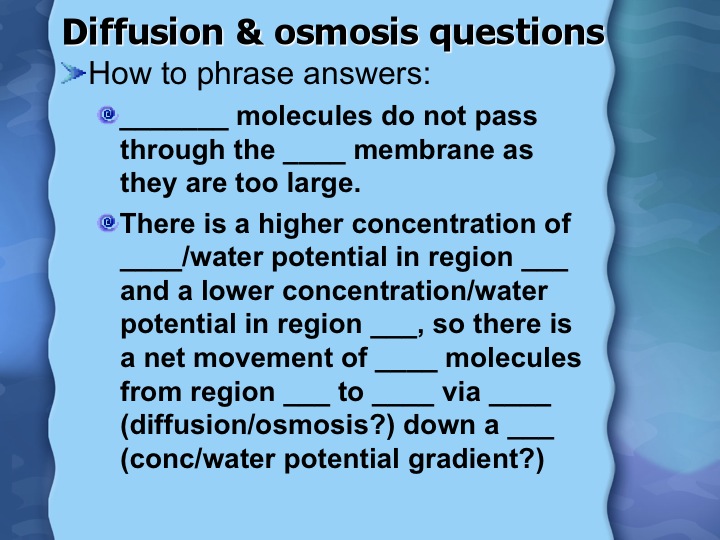
Use the template that is on the blog to help you phrase your answers!
1. Plant cells have a cell wall, which allows for only slight changes in size, and also prevents lysis of the cells.
2. Plant cells have large central vacuoles, which are not present in animal cells. Hence during osmosis, water moves between cell sap in central vacuole and the solution surrounding the cells. For animal cells, water moves between cytoplasm and the solution surrounding the cells.
Cell surface membranes affect the entry and exit of water and substances.
Factors that affect diffusion and osmosis are:
1. Surface area available: An increase in surface area leads to an increase in rate of diffusion and osmosis.
2. Permeability of membranes: Usually cell membranes are partially permeable. However, when membranes are exposed to organic solvents which dissolve the lipid bilayer (eg. ethanol or ether), or when cells are heated, the structure of the lipid bilayer is disrupted. This means that the membrane becomes fully permeable, which allows larger molecules inside the cell (eg. proteins) to diffuse out of the cell.
Points to Note for Structured Qn on Osmosis:
Turgid, Flaccid and Plasmolysis are terms used only for PLANT cells.
Instead, for a RBC, terms like haemolysis (bursting or lysis) and crenation (shrinkage) should be used.
Terms such as Exosmosis and Endosmosis should be used when referring to living cells only. The term Osmosis should be used when referring to experiments with non-living membranes such as visking tubings/dialysis tubings.
When referring to osmosis, use the term water potential, not water concentration as well as water potential gradient, not concentration gradient.
State specifically the shape of the RBC as being flattened and bi-concave.
If there is equal water potential in both cell and solution, state that the water potential gradient is zero resulting in no net movement of water molecules, thus no osmosis.
Use the template that is on the blog to help you phrase your answers!
Question on Enzymes
Describe how you would investigate the effect of temperature changes on the activity of the enzyme amylase. [10m]
1. Use a dropper to place drops of iodine solution on a white tile.
2. Label five test tubes 10, 30, 50, 70, 90 to indicate the temperatures at which they would be incubated at and add 10 cm3 of starch suspension into each of these tubes.
3. Use the five beakers provided to set up water baths maintained at temperatures of 100C, 300C, 500C, , 700C and 900C respectively.
4. Place each of these tubes in their corresponding water baths and leave them for 10 minutes.
5. After 10 minutes, add 1 cm3 of amylase solution into each test tube and shake the test tube gently. Immediately after adding the amylase solution, start the stopwatch and return the tube to the water bath.
6. Use clean plastic droppers to remove one drop from each of the starch-amylase mixtures and add them to the iodine droplets on the white tile to test for the presence of starch.
7. Repeat step 6 at regular intervals of 2 minutes for the next 15 minutes, and ensure that the temperature of the water baths does not fluctuate too much.
8. For each of the test tubes, record the time taken for starch to be digested completely (when iodine solution remains yellow).
9. Plot a graph of the time taken for the complete digestion of starch against temperature.
10.The shorter the time taken to digest the starch, the faster the rate of reaction indicating faster enzyme activity.
1. Use a dropper to place drops of iodine solution on a white tile.
2. Label five test tubes 10, 30, 50, 70, 90 to indicate the temperatures at which they would be incubated at and add 10 cm3 of starch suspension into each of these tubes.
3. Use the five beakers provided to set up water baths maintained at temperatures of 100C, 300C, 500C, , 700C and 900C respectively.
4. Place each of these tubes in their corresponding water baths and leave them for 10 minutes.
5. After 10 minutes, add 1 cm3 of amylase solution into each test tube and shake the test tube gently. Immediately after adding the amylase solution, start the stopwatch and return the tube to the water bath.
6. Use clean plastic droppers to remove one drop from each of the starch-amylase mixtures and add them to the iodine droplets on the white tile to test for the presence of starch.
7. Repeat step 6 at regular intervals of 2 minutes for the next 15 minutes, and ensure that the temperature of the water baths does not fluctuate too much.
8. For each of the test tubes, record the time taken for starch to be digested completely (when iodine solution remains yellow).
9. Plot a graph of the time taken for the complete digestion of starch against temperature.
10.The shorter the time taken to digest the starch, the faster the rate of reaction indicating faster enzyme activity.
March Holiday Assignment!
Dear Marists,
Here is the March Holiday assignment for Biology.
1. WS 4.1-4.3
2. TYS Unit 1.2 (All Questions)
3. Ecology Topic 9, Self Study
4. Research Project (Pair work)
RESEARCH PROJECT DETAILS
For the research project, you will need to work with a partner. You can choose anyone that you would like to work with. You may choose 1 topic from the following 2 topics.
A. Stem Cells
B. Trans-Fat
You will need to come up with 5 powerpoint slides.
Prepare the 5 powerpoint slides, for use in a presentation to a non-scientific audience on the topic area.
That means that the slides must be comprehensive enough to include the science behind the topic but must be presented in a simple way so that all can understand.
These assignments are due on the first lesson for Biology when school reopens in Term 2.
Please upload the ppt slide in your e-portfolio. The both of you must upload it into your own e-portfolio. Please name your slide 'Biology Research (Stem cell/Trans fat) Class 3_, No _ and _'
Here is the March Holiday assignment for Biology.
1. WS 4.1-4.3
2. TYS Unit 1.2 (All Questions)
3. Ecology Topic 9, Self Study
4. Research Project (Pair work)
RESEARCH PROJECT DETAILS
For the research project, you will need to work with a partner. You can choose anyone that you would like to work with. You may choose 1 topic from the following 2 topics.
A. Stem Cells
B. Trans-Fat
You will need to come up with 5 powerpoint slides.
Prepare the 5 powerpoint slides, for use in a presentation to a non-scientific audience on the topic area.
That means that the slides must be comprehensive enough to include the science behind the topic but must be presented in a simple way so that all can understand.
These assignments are due on the first lesson for Biology when school reopens in Term 2.
Please upload the ppt slide in your e-portfolio. The both of you must upload it into your own e-portfolio. Please name your slide 'Biology Research (Stem cell/Trans fat) Class 3_, No _ and _'
Diffusion, Osmosis and Active Transport: Summary
Molecules in a liquid, aqueous solution or a gas would have kinetic energy and would be moving in random directions.
If there are more of a specific type of molecule in one region and less in another region, you will find that the distribution of these molecules will even out after some time.
This NET (overall) movement of molecules from the more concentrated region to the less concentrated region is known as DIFFUSION.
The stage where the molecules are evenly distributed is known as DYNAMIC EQUILIBRIUM. (DYNAMIC: Molecules are still moving in random directions, EQUILIBRIUM: Molecules are evenly distributed)
This movement occurs spontaneously and does not require energy: PASSIVE TRANSPORT.
A similar kind of movement occurs when water molecules are involved. When this occurs across a partially permeable membrane, we call this process OSMOSIS.
Both osmosis and diffusion occur DOWN a water potential/concentration GRADIENT.
Water always enters and leaves the cells and bloodstream through osmosis.
For other solutes, eg. glucose, cells usually cannot just rely on diffusion to take in glucose (as it only enables cells to take up glucose until equilibrium is reached). Hence usually cells will sometimes pump in solutes using energy: ACTIVE TRANSPORT.
Main factors affecting diffusion/osmosis:
Temperature: Increasing temp makes the molecules gain KE. More KE, faster movement, faster rate of diffusion.
Surface area of membrane across which transport of molecules occurs: Increasing surface area means more molecules can cross the membrane at any one time, this increases rate of diffusion.
Gradient: The steeper the gradient (ie, the greater the difference in conc between the 2 regions), the faster the rate of diffusion.


If there are more of a specific type of molecule in one region and less in another region, you will find that the distribution of these molecules will even out after some time.
This NET (overall) movement of molecules from the more concentrated region to the less concentrated region is known as DIFFUSION.
The stage where the molecules are evenly distributed is known as DYNAMIC EQUILIBRIUM. (DYNAMIC: Molecules are still moving in random directions, EQUILIBRIUM: Molecules are evenly distributed)
This movement occurs spontaneously and does not require energy: PASSIVE TRANSPORT.
A similar kind of movement occurs when water molecules are involved. When this occurs across a partially permeable membrane, we call this process OSMOSIS.
Both osmosis and diffusion occur DOWN a water potential/concentration GRADIENT.
Water always enters and leaves the cells and bloodstream through osmosis.
For other solutes, eg. glucose, cells usually cannot just rely on diffusion to take in glucose (as it only enables cells to take up glucose until equilibrium is reached). Hence usually cells will sometimes pump in solutes using energy: ACTIVE TRANSPORT.
Main factors affecting diffusion/osmosis:
Temperature: Increasing temp makes the molecules gain KE. More KE, faster movement, faster rate of diffusion.
Surface area of membrane across which transport of molecules occurs: Increasing surface area means more molecules can cross the membrane at any one time, this increases rate of diffusion.
Gradient: The steeper the gradient (ie, the greater the difference in conc between the 2 regions), the faster the rate of diffusion.

Common Test 1 23/2
Section A: 10 MCQs (10 marks)
Section B: Structured Questions (30 marks)
Section C: Essay Question (10 marks)
Answer all questions.
Time: 1 Hr
Topic 1: Cells
T2: Biomolecules + Food Tests
T3: Enzymes
Please make sure you have a sharp pencil and an eraser and your other necessary stationary with you. You will also need your calculator.
Manage your time well.
You are advised to spend a max of 20 mins on Section A: MCQ.
Section B: Structured Questions (30 marks)
Section C: Essay Question (10 marks)
Answer all questions.
Time: 1 Hr
Topic 1: Cells
T2: Biomolecules + Food Tests
T3: Enzymes
Please make sure you have a sharp pencil and an eraser and your other necessary stationary with you. You will also need your calculator.
Manage your time well.
You are advised to spend a max of 20 mins on Section A: MCQ.
Enzymes
ENZYME: biological catalyst made of protein which alter the rate of chemical reactions, remaining unchanged at the end of reaction.
SUBSTRATE: substances upon which enzymes act.
WHY BIOLOGICAL?
Produced by living cells
Protein in nature (and hence can be denatured by extreme pH and heat)
WHY CATALYSTS?
Alter rate of chemical reactions
But are not changed at the end of the reaction
Hence required in minute (ie small) amounts as they can be REUSED
Lock & Key Hypothesis
To explain why enzymes are SPECIFIC in action
Enzyme = Lock
Substrate = Key
For key to fit into lock, it has to have a shape that is COMPLEMENTARY to the shape of the lock. Similarly, for the enzyme to act on the substrate, the substrate must have a shape that is COMPLEMENTARY to the ACTIVE SITE of the enzyme.
Why are enzymes important?
Enable all the chemical reactions in the body to run, without requiring extreme conditions like high heat.
Hence body must maintain a suitable environment for enzymes to function as near optimum as possible.
Commonly used terms:
1. Control: Set-up used to provide standard conditions to be compared with experimental conditions, to study the effect of a factor on a process by removing or varying the factor. In enzyme experiments, the control set-up usually shows that the changes observed are due to the action of the enzyme (eg. oxygen gas produced is due to action of catalase). The control usually involves a similar set-up, but uses boiled enzyme that would be denatured, and hence will not be able to produce a reaction.
2. Action of enzyme: Basically used to refer to the effect of the enzyme (eg. Action of catalase- Breaks down hydrogen peroxide into oxygen which appears as froth.)
3. Chemical nature: Refers to what kind of chemical makes up the molecule, and the characteristics of the chemical (eg. protein in nature means the molecules can be denatured by high heat/extreme pH). Read up important concepts for temp and pH effects on enzymes in notes.

4. Rate of reaction: Measure of how fast a reaction is running, based on
a. Amount of substrate used up/Time taken
b. Amount of product formed/Time taken
5. Effects of Substrate and Enzyme Concentration
Terms to take note of:
• Limiting factor: A factor that directly affects the rate at which chemical reaction progresses. Increasing quantity of this factor will increase the rate of reaction.
• End Point: Reaction has been completed. All substrates have been used up.
• Saturation Point: All the enzymes have been made use of. Enzyme concentration is the limiting factor.
*For enzyme graphs;
take note of the axes, gradient of the curves and where the curve plateaus.
SUBSTRATE: substances upon which enzymes act.
WHY BIOLOGICAL?
Produced by living cells
Protein in nature (and hence can be denatured by extreme pH and heat)
WHY CATALYSTS?
Alter rate of chemical reactions
But are not changed at the end of the reaction
Hence required in minute (ie small) amounts as they can be REUSED
Lock & Key Hypothesis
To explain why enzymes are SPECIFIC in action
Enzyme = Lock
Substrate = Key
For key to fit into lock, it has to have a shape that is COMPLEMENTARY to the shape of the lock. Similarly, for the enzyme to act on the substrate, the substrate must have a shape that is COMPLEMENTARY to the ACTIVE SITE of the enzyme.
Why are enzymes important?
Enable all the chemical reactions in the body to run, without requiring extreme conditions like high heat.
Hence body must maintain a suitable environment for enzymes to function as near optimum as possible.
Commonly used terms:
1. Control: Set-up used to provide standard conditions to be compared with experimental conditions, to study the effect of a factor on a process by removing or varying the factor. In enzyme experiments, the control set-up usually shows that the changes observed are due to the action of the enzyme (eg. oxygen gas produced is due to action of catalase). The control usually involves a similar set-up, but uses boiled enzyme that would be denatured, and hence will not be able to produce a reaction.
2. Action of enzyme: Basically used to refer to the effect of the enzyme (eg. Action of catalase- Breaks down hydrogen peroxide into oxygen which appears as froth.)
3. Chemical nature: Refers to what kind of chemical makes up the molecule, and the characteristics of the chemical (eg. protein in nature means the molecules can be denatured by high heat/extreme pH). Read up important concepts for temp and pH effects on enzymes in notes.

4. Rate of reaction: Measure of how fast a reaction is running, based on
a. Amount of substrate used up/Time taken
b. Amount of product formed/Time taken
5. Effects of Substrate and Enzyme Concentration
Terms to take note of:
• Limiting factor: A factor that directly affects the rate at which chemical reaction progresses. Increasing quantity of this factor will increase the rate of reaction.
• End Point: Reaction has been completed. All substrates have been used up.
• Saturation Point: All the enzymes have been made use of. Enzyme concentration is the limiting factor.
*For enzyme graphs;
take note of the axes, gradient of the curves and where the curve plateaus.
To all Sec 3 Pure Biology Students..
Please note that this blog will be used for uploading summaries, things to note, reminders, as well as practice questions especially when the exams draw nearer. Should you have questions that are not addressed during lessons, you can also ask your questions in the comments section (Do remember to leave your name and class when you post questions).
Materials needed for Pure Biology
Materials needed for Pure Biology:
1 Large Ring Binder Green File
3 Dividers (Exercise, TYS, Exam)
Goggles
TYS ($7.50)
Notesbook 1 (will be issued to you on your first theory lesson)
Practical workbook (will be issued to you on your first practical lesson)
Expectations:
Read up topic in your Textbook prior to lesson.
Every Theory and Practical Lesson: Bring Notesbook
Summary Concept map to be done and submitted after each topic.
Please update E-portfolio after every topic.
1 Large Ring Binder Green File
3 Dividers (Exercise, TYS, Exam)
Goggles
TYS ($7.50)
Notesbook 1 (will be issued to you on your first theory lesson)
Practical workbook (will be issued to you on your first practical lesson)
Expectations:
Read up topic in your Textbook prior to lesson.
Every Theory and Practical Lesson: Bring Notesbook
Summary Concept map to be done and submitted after each topic.
Please update E-portfolio after every topic.
Cell Structure: A Summary
Cells are basic structural & functional units of all living organisms.
 For cells to function effectively, they must be able to:
1. Carry out metabolic reactions essential to life (Mainly in cytoplasm)
---> In the cytoplasm are organelles which are structures surrounded by membranes. These "compartments" carry out specific reactions/ functions, eg. Mitochondria and chloroplasts contain enzymes for respiration and photosynthesis respectively, while vacuoles may transport waste material out of the animal cell, and help to keep the cells firm in plant cells.
2. Have genetic material that will control those reactions, plus provide a template to make new cells that are identical (Stored in chromatin in nucleus).
3. Have a partially permeable boundary surrounding the entire cell, which allows the cell to control its internal environment and maintain concentration of solutes and its water potential and pH, as this will affect the chemical reactions going on inside the cell (Cell surface membrane).
Collectively, the cell is made up of protoplasm (living matter), consisting of the cell surface membrane, the nucleus and the cytoplasm.
 Plant cells have specialised structures not found in animal cells:
1. Chloroplasts: Used to trap light energy and carry out the process of photosynthesis.
2. A large central vacuole: (Animal cells have numerous small vacuoles.) This vacuole is surrounded by a membrane known as a tonoplast, and is filled with cell sap. These large central vacuoles are seen in most mature (older) plant cells.
3. Cell wall: Helps the cell to keep its shape, and plays a role in enabling cells to be turgid. One main component is cellulose, which gives the cell wall its strength. Its fully permeable and non-living.
4. Middle lamella: Cementing material found between plant cells. Fully permeable and non-living.
 For cells to function effectively, they must be able to:
1. Carry out metabolic reactions essential to life (Mainly in cytoplasm)
---> In the cytoplasm are organelles which are structures surrounded by membranes. These "compartments" carry out specific reactions/ functions, eg. Mitochondria and chloroplasts contain enzymes for respiration and photosynthesis respectively, while vacuoles may transport waste material out of the animal cell, and help to keep the cells firm in plant cells.
2. Have genetic material that will control those reactions, plus provide a template to make new cells that are identical (Stored in chromatin in nucleus).
3. Have a partially permeable boundary surrounding the entire cell, which allows the cell to control its internal environment and maintain concentration of solutes and its water potential and pH, as this will affect the chemical reactions going on inside the cell (Cell surface membrane).
Collectively, the cell is made up of protoplasm (living matter), consisting of the cell surface membrane, the nucleus and the cytoplasm.
 Plant cells have specialised structures not found in animal cells:
1. Chloroplasts: Used to trap light energy and carry out the process of photosynthesis.
2. A large central vacuole: (Animal cells have numerous small vacuoles.) This vacuole is surrounded by a membrane known as a tonoplast, and is filled with cell sap. These large central vacuoles are seen in most mature (older) plant cells.
3. Cell wall: Helps the cell to keep its shape, and plays a role in enabling cells to be turgid. One main component is cellulose, which gives the cell wall its strength. Its fully permeable and non-living.
4. Middle lamella: Cementing material found between plant cells. Fully permeable and non-living.
Role of water in living organisms:ADDITIONAL NOTES
• The ability of water to absorb heat enables water to absorb heat produced by the metabolic activities of the cells. As blood is moved from the region of heat production (e.g. the liver and muscle tissues), heat is removed.
• The ability to absorb heat before showing a change in temperature also means that much energy will be needed to convert liquid water into water vapour. Evaporation of sweat is thus a major means of removing heat from the body surface and thus reducing body temperature.
• The unique decrease in density of water as it becomes ice results in ice floating over slightly warmer water. This not only helps insulate the water from further loss of heat, but also ensures the survival of fish and other aquatic organisms in winter.
• Being such a good solvent, water forms a large part of the cytoplasm of the cell, tissue fluid as well as the transporting medium in blood, excretory system, alimentary canal, xylem, phloem.
This means that water:
- must be present whenever biochemical reactions in the cell take place;
- must be present for oxygen and carbon dioxide to diffuse into and out of the body;
- is an important part of the digestive juices;
- is an important solvent for metabolic wastes such as urea.
- In plants, water is also important because it helps the plant cells maintain turgor pressure and keep their shape. It is also an essential part of the process of photosynthesis.
• The ability to absorb heat before showing a change in temperature also means that much energy will be needed to convert liquid water into water vapour. Evaporation of sweat is thus a major means of removing heat from the body surface and thus reducing body temperature.
• The unique decrease in density of water as it becomes ice results in ice floating over slightly warmer water. This not only helps insulate the water from further loss of heat, but also ensures the survival of fish and other aquatic organisms in winter.
• Being such a good solvent, water forms a large part of the cytoplasm of the cell, tissue fluid as well as the transporting medium in blood, excretory system, alimentary canal, xylem, phloem.
This means that water:
- must be present whenever biochemical reactions in the cell take place;
- must be present for oxygen and carbon dioxide to diffuse into and out of the body;
- is an important part of the digestive juices;
- is an important solvent for metabolic wastes such as urea.
- In plants, water is also important because it helps the plant cells maintain turgor pressure and keep their shape. It is also an essential part of the process of photosynthesis.
Some confusing terms starting with E...
Ok, some terms starting with "e" that are causing some confusion:
Epithelium/epithelial cells: Tissue that makes up the layer that covers the surface of organs, cavities, vessels and tubes in animals, like the surface of the gut (eg, villi of the ileum).
Endothelium:A type of epithelium that lines the inner surface of the blood vessels (eg, one cell thick capillary wall).
Epidermis/epidermal cells:Makes up the layer that covers the surface of plant parts, like the roots, stem and leaves as well as the surface of human skin (epidermal layer).
Epithelium/epithelial cells: Tissue that makes up the layer that covers the surface of organs, cavities, vessels and tubes in animals, like the surface of the gut (eg, villi of the ileum).
Endothelium:A type of epithelium that lines the inner surface of the blood vessels (eg, one cell thick capillary wall).
Epidermis/epidermal cells:Makes up the layer that covers the surface of plant parts, like the roots, stem and leaves as well as the surface of human skin (epidermal layer).
Some terms in Nutrition
Ingestion: Intake of food into the body (Feeding)
Digestion: Process where large food molecules are broken down into soluble and diffusible molecules that can be absorbed into the body cells. Alimentary canal usually has a section with a storage function (eg. Stomach)
Absorption: Process where digested food materials are taking into the body cells
Assimilation: Process where some of the absorbed food materials are converted into new protoplasm or used to provide energy
Egestion: Removal of undigested matter from the body (Defaecation)
Distinguish clearly between the following pairs of terms:
A) Nutrition & Tissue Respiration
Nutrition is changing food into part of the body (protoplasm); [1]
Respiration is changing food into energy by oxidation; [1]
Nutrition includes ingestion / the intake of food, respiration does not; [1]
Nutrition results in growth, whereas respiration does not result that; [1]
B) Digestion & Assimilation
Digestion is the Breakdown of complex food substances in the digestive system (in the mouth / stomach / small intestine or alimentary canal) into simpler substances; [1]
Assimilation is the synthesis of complex organic compounds (from simple substances); [1]
Assimilation involves chemical reactions that take place in living cells, therefore it is a metabolic reaction, whereas digestion is not taking place in living cells, thus it is not a metabolic reaction; [2]
C) Metabolic wastes & faeces
Metabolic wastes - waste products produced by chemical reactions, taking place in living cells;
Faeces - referring to the undigested, unabsorbed matter;
Digestion: Process where large food molecules are broken down into soluble and diffusible molecules that can be absorbed into the body cells. Alimentary canal usually has a section with a storage function (eg. Stomach)
Absorption: Process where digested food materials are taking into the body cells
Assimilation: Process where some of the absorbed food materials are converted into new protoplasm or used to provide energy
Egestion: Removal of undigested matter from the body (Defaecation)
Distinguish clearly between the following pairs of terms:
A) Nutrition & Tissue Respiration
Nutrition is changing food into part of the body (protoplasm); [1]
Respiration is changing food into energy by oxidation; [1]
Nutrition includes ingestion / the intake of food, respiration does not; [1]
Nutrition results in growth, whereas respiration does not result that; [1]
B) Digestion & Assimilation
Digestion is the Breakdown of complex food substances in the digestive system (in the mouth / stomach / small intestine or alimentary canal) into simpler substances; [1]
Assimilation is the synthesis of complex organic compounds (from simple substances); [1]
Assimilation involves chemical reactions that take place in living cells, therefore it is a metabolic reaction, whereas digestion is not taking place in living cells, thus it is not a metabolic reaction; [2]
C) Metabolic wastes & faeces
Metabolic wastes - waste products produced by chemical reactions, taking place in living cells;
Faeces - referring to the undigested, unabsorbed matter;
Subscribe to:
Posts (Atom)